
Arrest Warrants in Fairfield Town
An arrest warrant is a court order that tells law enforcement to take a named person into custody. In Connecticut the order needs probable cause. A judge reviews the supporting application or case material before signing anything. C.G.S. § 54-2a is the central state source for how that court warrant process works. Fairfield is a town, not a countywide criminal-court hub. Its local arrests can involve Fairfield Police, but the criminal dockets run through Connecticut Superior Court. Bridgeport GA2 handles many geographical-area matters, while serious Part A cases go to the Bridgeport Judicial District location. Fairfield has no municipal criminal court of its own. Connecticut also has no county sheriff desk in this chain, so a Fairfield warrant check points to the court and the police department, not to some other county office.
Fairfield Warrant System Path
Connecticut splits a warrant into four stages: issue, entry into operational systems, service, and any public display. The Criminal and Motor Vehicle Court Case Management System, called CRMVS, feeds warrant data into the Paperless Arrest Warrant Network. Authorized agencies reach PRAWN through channels such as COLLECT or CISS. Those tools let courts and police act on warrant information fast. They are not open public search engines. The official PRAWN description lays out the system's statewide role, which is why Fairfield warrant information may exist in state hands yet never appear on a public page.
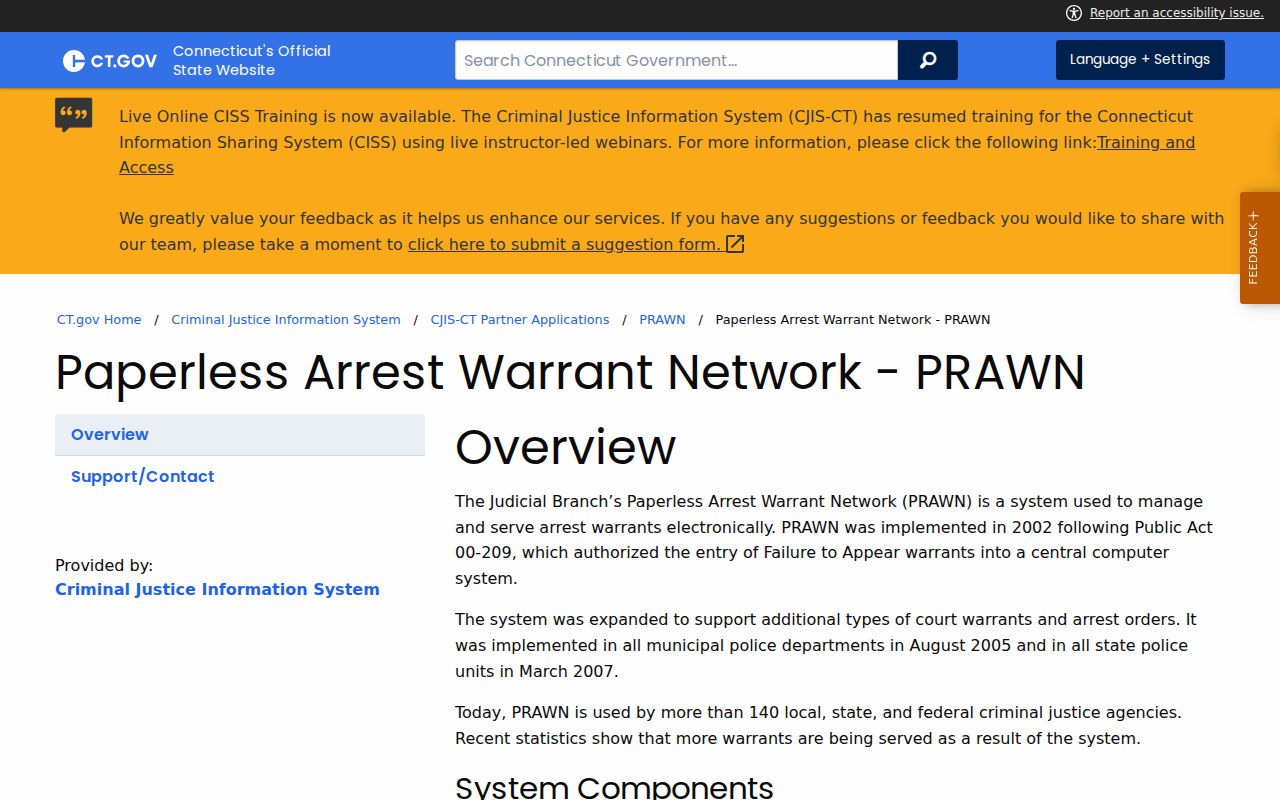
That system view explains the gap: Fairfield Police can hold authorized operational data on an active warrant while no public court page shows it.
What a Fairfield Arrest Warrant Contains
A current court record can show the warrant's key parts along with its case details. Public displays rarely include the full signed order or the supporting affidavit. Treat any gap with care. Never fill in a missing value yourself, and never act on a docket-like number from an unsolicited caller before checking the official record.
| Case or warrant identifier | A number that links the order to the court matter; Connecticut does not promise one public universal format. |
|---|---|
| Named subject | The person identified by the order, checked with neutral identifiers to reduce name-match errors. |
| Alleged offense | The cited charge or legal basis, which is an allegation rather than a conviction. |
| Issuing court | The Superior Court location and judge connected to the order. |
| Issue and service status | Dates or labels that distinguish authorization from execution. |
| Bond information | Any stated amount or release condition, subject to current court action. |
Fairfield Public Search Boundaries
Two state tools help with a Fairfield warrant search, but each has limits. The pending criminal and motor-vehicle search builds case context. You can query it by last name, first initial, birth year or a year range, court location, and case category. The VOP/FTA warrant page is narrower, and it says so itself. It does not cover every warrant type, and it warns against acting on anyone because of a result. Neither tool is a public Fairfield warrant roster, because the Town and its Police Department post none. So a blank result does not prove that no Fairfield arrest warrant exists. Sealed matters, juvenile and youthful-offender records, orders signed moments ago, and safety-sensitive material may simply be absent. Verify your own possible match with the clerk, your lawyer, or an official police contact before drawing conclusions.
Key point: Public court data is preliminary. The clerk’s official record controls when a Fairfield arrest warrant status is uncertain.
How Fairfield Arrest Warrants Are Served
Serving a Fairfield arrest warrant starts on the street. The Fairfield Police Patrol Division handles wanted-person apprehension, prisoner control, and motor-vehicle enforcement, with mobile access to local, state, and national information. That is an operational role, though, not a public roster of outstanding warrants. Any Fairfield officer can confirm and serve an active warrant during a traffic stop, an investigation, or another lawful encounter. What happens next depends on the order and current law. Booking, release, and presentation before the court follow arrest. Service can reach beyond Connecticut, too. A Fairfield Police news item from 2026 described detectives obtaining a warrant, locating a person outside Connecticut, and working with the U.S. Marshals Service to coordinate the return. The takeaway is simple. Interstate execution of a warrant may call for authorized agency coordination.
Fairfield Issued Versus Served
One word can change the meaning of a Fairfield warrant record. "Issued" means the court authorized the arrest. "Outstanding" generally means it is still open, though only a live clerk or police check confirms current status. "Served" means an officer executed it. "Recalled" means the issuing court withdrew it. A news report of an arrest, on its own, never states the final court result.
- Probable cause
- Facts sufficient for a judge to authorize the arrest process, not proof beyond a reasonable doubt.
- Affidavit
- A sworn statement used to support an application; access may be delayed or restricted.
- PRAWN
- Connecticut’s restricted Paperless Arrest Warrant Network for authorized justice users.
- Service
- Execution of the warrant by an authorized officer.
- Recall or quash
- Court action that withdraws or sets aside an order; only official verification confirms it.
Fairfield Arrest, Summons, Bench Warrants
These legal tools call for different responses. A summons directs a person to appear without ordering arrest first. An arrest warrant, by contrast, tells officers to take a named person into custody on probable cause. A Fairfield bench warrant typically follows a missed duty in an existing case, such as a required appearance.
| Feature | Arrest Warrant | Summons | Bench Warrant |
|---|---|---|---|
| Main command | Arrest the named person | Appear on the stated date | Arrest for an unmet court duty |
| Usual basis | Probable cause of an alleged offense | A charge handled without initial custody | Failure to appear or comply |
| Response | Plan surrender and bond with counsel | Attend as directed | Contact the issuing court and counsel |
| Record source | Court plus authorized police systems | Court notice and docket | Existing docket and issuing clerk |
For missed-court procedures, see the separate Fairfield bench warrants reference.
Fairfield Arrest Record Access
After an arrest in Fairfield, an eligible incident or arrest record can be requested from Fairfield Police Records. Connecticut's public-records statute, including C.G.S. § 1-215, sets the baseline for access to records of arrest. That baseline has limits. Affidavits, videos, witness statements, evidence files, and investigative notes do not become public automatically, and a sealing order or statutory exemption can block release. The Fairfield Police FOIA request form offers an optional CFS or incident-number field, so identify the record and the event as precisely as you can. The Records unit handles public copies, while the Superior Court clerk is the better source for the official docket and present warrant status. A FOIA request cannot turn a restricted PRAWN screen into an open list.
Fairfield State and Federal Warrants
Fairfield criminal cases usually land in Connecticut Superior Court. Federal warrants follow a different track. The U.S. District Court for the District of Connecticut sits in Bridgeport, and its federal Bridgeport courthouse is where those dockets live. Public access to federal dockets runs through PACER's specific-court search, subject to account, fee, sealing, and record limits. Even PACER offers no complete public federal-warrant roster. Anyone worried about a federal warrant needs counsel, the federal clerk, or an independently verified U.S. Marshals contact. Fairfield Police's local records desk cannot resolve a federal court order. A state court search is never a federal-warrant check. Call the right desk. Note: Connecticut state marshals also differ from a county sheriff, and Fairfield has no modern county-sheriff warrant channel to call.
Handle Your Fairfield Arrest Warrant
A possible match is only a lead. Verify it before acting. Pull the official docket to learn which court issued the Fairfield warrant. Then reach a lawyer or the clerk at a number you find yourself in the Judicial Directory. Counsel can arrange a voluntary surrender, address bond, and ask the court whether a motion to recall or quash is legally available, since the right route depends on the warrant and the case.
- Record the docket, court location, and exact status displayed by the official source.
- Verify the information with the issuing clerk or a lawyer.
- Plan a surrender or court appearance rather than waiting for an unplanned police encounter.
- Follow only the bond and release directions tied to the current court order.
Important: An active arrest warrant can lead to custody. Discuss surrender, bond, and any recall motion with an attorney first.
Fairfield Warrant Payment Scams
Scammers love a warrant story. A caller says a Fairfield arrest is minutes away, quotes a docket-like number, then demands a gift card, crypto, a wire, or a payment link. Hang on. Real courts do not do business that way. The Connecticut Department of Consumer Protection warns that no court demands money or personal details through cold calls, texts, or emails. So end the contact fast. Look up the Fairfield clerk or police number yourself and ask whether any such order exists. Under C.G.S. § 54-64b, bond and release after an arrest on a court warrant stay in the court's hands, case by case. The Fairfield civil citation portal, the DMV fee portal, and police record-copy payments are not bond sites. A caller who insists otherwise is working a scam, not a warrant.