
Bench Warrants in Fairfield Town
Think of a Fairfield bench warrant as an arrest order tied to a duty the person already owes the court. The classic example is the FTA warrant, short for failure to appear. Skip a criminal, motor-vehicle, or infraction date, and a judge can put one in play. A judge can also issue a related order when someone ignores a required condition. None of this settles the case itself. A missed appearance is a procedural step, not a final outcome. Connecticut statutes also use the word capias. In Fairfield that term belongs entirely to the state court process, so do not map it onto the Texas-style "capias pro fine" a town court might issue. Fairfield runs no municipal criminal court and keeps no public capias book. The record that matters normally sits in the Connecticut Superior Court system.
Fairfield FTA Search Limits
The Connecticut Judicial Branch VOP/FTA search is built with tight limits. You can query by last name, first name, date of birth, town, court location, and an optional state identification number. But the current notice says failure-to-appear warrants will not be displayed until further notice. The same source admits it omits some warrant types and warns against acting on it against anyone. That is why a Fairfield public query is only a first check, never the final word on a bench warrant.
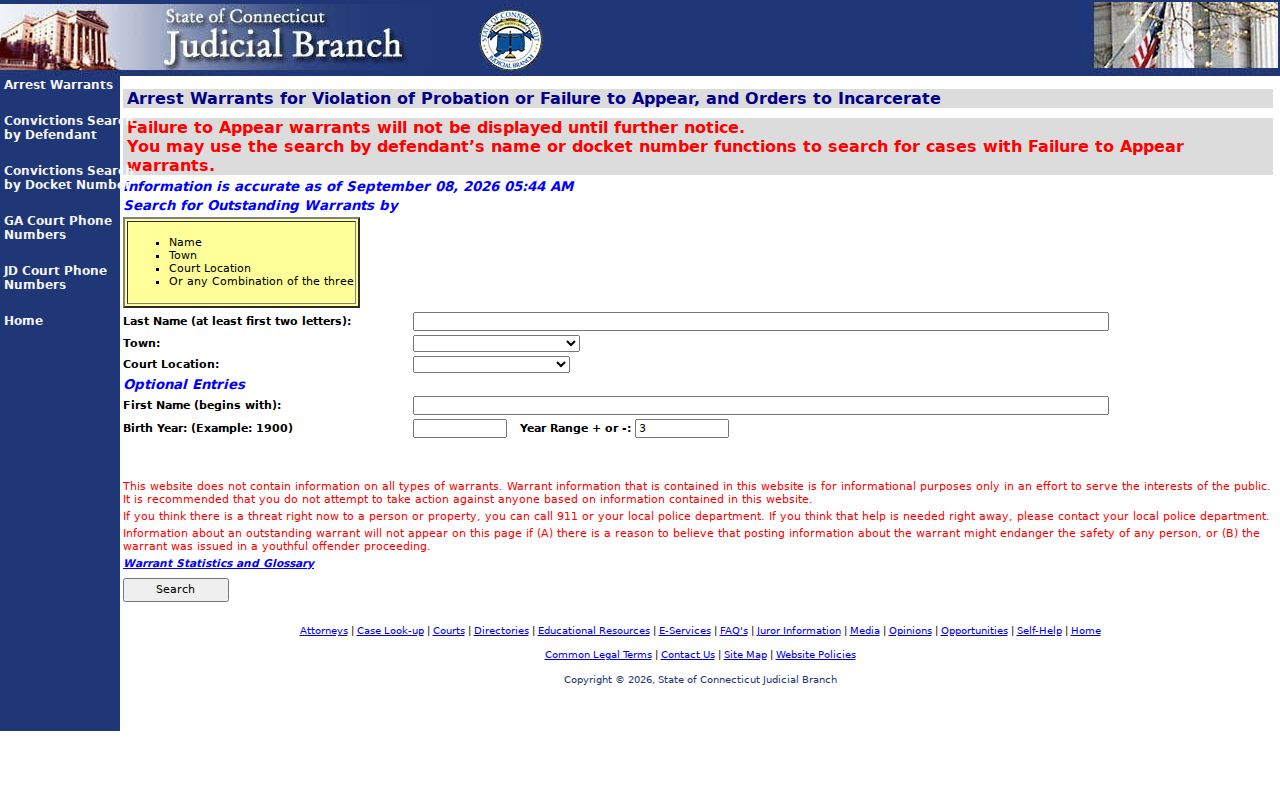
For a Fairfield bench warrant, that notice makes clerk verification essential even when the search returns nothing.
Caution: A blank FTA result is not a clearance, recall, or finding that no Fairfield bench warrant exists.
How a Bench Warrant Is Issued
Every Fairfield bench warrant starts with a court obligation. When the person fails to appear as ordered, a judge may authorize arrest for the nonappearance. Connecticut General Statutes § 54-2a is a key criminal-process source for bench warrants, capias, and related court orders. Once issued, warrant data can flow from the court case-management system into the restricted statewide operational network reserved for authorized justice agencies. Issuance and service are separate events. "Issued" means the judge authorized it. "Served" means an officer executed it. A warrant can sit outstanding between those two points. A later court order may recall it, though only the court record can confirm that change. An old online entry, a missing entry, and a recalled order are three different facts, not interchangeable ones.
Fairfield Missed Court Steps
Anyone who may have missed a Fairfield court date should trace the underlying case before acting. The pending criminal and motor-vehicle case search needs only a last name, with optional fields like first initial, birth year, filing-year range, court location, and case category. It gives docket context. It is not the official record.
- Search the official pending-case page for the relevant criminal or motor-vehicle docket.
- Check the court-location field for Bridgeport GA2 or another assigned court.
- Call the listed clerk using a number found independently in the Judicial Directory.
- Ask counsel or the clerk what lawful appearance, reopening, or surrender process applies.
Skip Fairfield's automated citation portal for any criminal court warrant. That tool handles civil safety-device notices, not Superior Court warrants.
Fairfield Bench and Arrest Warrants
Both Fairfield instruments authorize arrest, but they grow from different roots. A bench warrant follows an unmet obligation in a case already before the court. An arrest warrant rests on a judge's finding of probable cause tied to an alleged offense. Which one you face shapes which record to seek and which issue to fix.
| Feature | Bench Warrant | Arrest Warrant |
|---|---|---|
| Typical trigger | Missed appearance or court duty | Probable cause of an alleged offense |
| Case posture | Usually tied to an existing docket | May begin or advance a criminal case |
| Status check | Case search, then issuing clerk | Court and authorized police channels |
| Next step | Appearance, reopening, or recall process | Planned surrender, bond, and court process |
The companion Fairfield arrest warrants reference explains probable cause and service in more depth.
Fairfield Warrant Terms Decoded
Connecticut's labels each point to a distinct event or authority. Keep them separate. The Judicial Branch failure-to-appear glossary is the safest guide for reading a status in a current Fairfield court record.
- FTA
- Failure to appear. A judge may authorize an arrest warrant after a required court appearance is missed.
- VOP
- Violation of probation. It is a distinct warrant category and should not be treated as an FTA.
- OTI
- Order to incarcerate. It is separately identified in Judicial Branch materials.
- Issued
- The court authorized the warrant. This does not mean it has been served.
- Served
- An authorized officer executed the warrant and the case moved to the next process.
- Recall
- The issuing court withdrew the warrant. A missing web result does not establish recall.
Resolve a Fairfield Bench Warrant
Only the issuing court, or another authorized process, can change a Fairfield bench warrant. Neither the Town nor Fairfield Police advertises a local warrant-amnesty day, clinic, or recall program. That is not a claim that relief is unavailable. It means the next step rides on the docket, the court order, and advice of counsel.
- Confirm the docket and issuing court through official court sources.
- Consult an attorney before an appearance or surrender when arrest is possible.
- Ask whether the case requires reopening, a scheduled appearance, or another court filing.
- Follow the issuing court’s instructions on bond, release, and the underlying obligation.
Caution: Do not ignore a bench warrant or assume an online payment will clear it. Court action is case-specific.
Fairfield Bond Payment Safeguards
Bond and release terms after an arrest on a court warrant depend on the case. C.G.S. § 54-64b is the focused Connecticut statute. Keep separate obligations separate: a police-record copy fee, a DMV reinstatement fee, a court fine, and a Fairfield civil citation payment are different things, and none of those payment systems is a warrant database or a way to lift a warrant. Connecticut's Department of Consumer Protection warning says courts never demand money or personal data through an unexpected call, text, or email. Hang up if a caller wants gift cards, cryptocurrency, a wire, or payment through an unverified link. Find the court number in an official directory and call it yourself.
Which Fairfield Court Issued It
A Fairfield arrest on a bench warrant answers to Connecticut Superior Court, since the state runs criminal matters rather than the towns. Most misdemeanors, infractions, and motor-vehicle cases are Part B matters handled at Geographical Area No. 2 in Bridgeport. Its clerk sits at 172 Golden Hill Street, Bridgeport, CT 06604. Call (203) 579-6560 for public information. Part A felonies, the serious charges, go instead to the Bridgeport Judicial District at 1061 Main Street.
Bridgeport GA2 Clerk
Use the Judicial Branch Directory to recheck the clerk and number before calling about a Fairfield bench warrant.
(203) 579-6560
Fairfield Police Records
100 Reef Road, Fairfield, CT 06824. Records may provide eligible police documents, but police records are not the issuing court’s official warrant status.
(203) 254-4800, option 1
Fairfield Bench Warrant Privacy
Public access stops at certain doors. Juvenile matters stay confidential in Bridgeport under C.G.S. § 46b-124. Youthful-offender, sealed, and safety-sensitive records can likewise be missing from any public interface, because PRAWN itself is an authorized criminal-justice network rather than a public database. A narrow request for a Fairfield Police incident or arrest record can go through the Town’s NextRequest portal, but that route cannot unlock a protected PRAWN screen or turn the police records unit into the court clerk. For a warrant's current status, verify the court record; for a police document, identify the incident as precisely as you can and expect lawful redactions. Note: Fairfield has no county sheriff warrant office, so any source pointing residents there misreads Connecticut's structure.